
Manus AI in March 2026: Features, Skills Update, Meta Backing, and Why It Is Trending
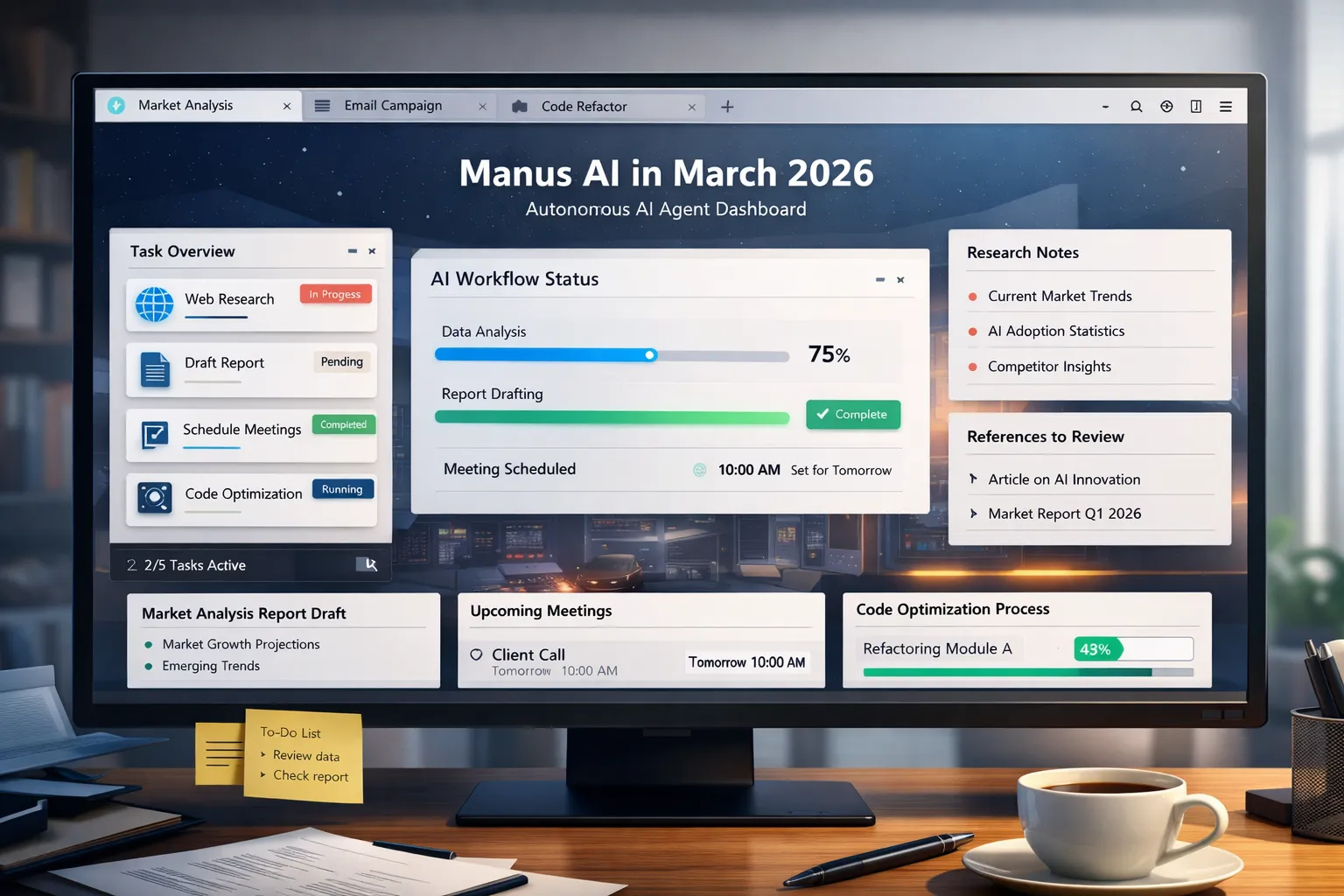
Manus AI is back in the conversation because the product is moving beyond a simple demo narrative and into a broader agent platform story. On its official homepage, Manus describes itself as a general AI agent that can turn thoughts into actions and complete practical tasks across browsing, research, analysis, and workflow execution. What makes this relevant in March 2026 is not just the original hype cycle. It is the steady stream of product updates around skills, learning resources, and broader ecosystem positioning. That combination is why Manus is still showing up in AI news coverage, founder discussions, and agentic AI comparisons.
What You Will Learn
In this update, you will learn: 1) What Manus AI actually does in practical terms 2) Which recent official updates matter most in early 2026 3) Why the product is often grouped with the new wave of agentic AI tools 4) Where Manus may fit for operators, founders, and research-heavy teams 5) The main limitations to validate before depending on it in production This is a current-status article, not a hype post. The goal is to give you a fast, usable picture of Manus as of March 11, 2026.
Best Tools for This Task
What stands out right now: - General agent positioning: Manus is framed as an AI that can take action, not only generate text - Real workflow angle: the product emphasizes browsing, research, and multi-step task completion - Skills update: official Manus posts in February 2026 highlighted improvements around reusable skills and execution workflows - Ecosystem expansion: official updates in January 2026 also introduced Manus Academy, which signals a push toward onboarding and use-case education - Corporate signal: Manus announced Meta acquisition news on December 29, 2025, which added another layer of attention around its long-term direction If you are comparing it with other AI tools, the core question is simple: do you need a chat assistant, or do you need an agent that can work across tasks with less manual steering?
Real World Use Cases
Best-fit use cases for Manus AI right now: - Market research that requires collecting and structuring information from multiple web sources - Founder or operator workflows where one agent handles repetitive browser tasks - Early-stage internal automation experiments for research, summaries, and execution checklists - Teams exploring agentic AI before building custom stacks in n8n, LangGraph, or code-first frameworks What to verify before adoption: - Reliability across long task chains - Permission handling and review checkpoints for sensitive work - Output consistency when tasks include niche facts or changing live data - Whether pricing and access model fit your actual weekly usage Practical takeaway: Manus is most interesting for users who want action-oriented AI workflows, not just a stronger chatbot.
Conclusion
As of March 11, 2026, Manus AI remains newsworthy because it sits at the center of two trends at once: agentic AI adoption and platform consolidation around high-execution assistants. The product looks strongest when you evaluate it as an agent workflow tool, not as a generic writing assistant. If your team is testing AI for research, ops support, or browser-driven execution, Manus is worth tracking closely. Best next step: run a narrow pilot with one workflow, define success metrics before you start, and compare Manus against your current stack on real tasks instead of launch-day excitement.
Continue Learning
Explore related resources to go deeper on this topic and discover practical tools.